
A working prototype feels different when real business risk appears: permissions, payments, data, recovery, and accountability.
A person, team, or company can now describe an app on Friday, generate the interface, wire up auth, connect a database, and demo something real by Monday.
That is a real shift. It also creates a new failure mode: the prototype can start to look like software before it has the guarantees software needs.
The vibe coding brick wall appears when the question changes from "does the demo work?" to "can the business depend on this?"
What is the vibe coding brick wall?
The vibe coding brick wall is the point where an AI-built prototype stops being judged by whether the demo works and starts being judged by whether it can survive production.
It usually appears when the product touches real users, customer data, payments, internal workflows, or investor diligence. At that point, the question changes from "can we build this?" to "can we trust this?"
What teams should know before the wall appears
- The wall usually appears after the prototype starts working.
- The first warning signs are business questions: Can we charge for this? Can customers or colleagues trust it? Can another engineer maintain it? Can we explain the permissions, data model, and failure paths?
- The risky parts are often invisible in the demo: authorization, data integrity, deployment, observability, dependency review, and recovery.
- The answer is not always a rebuild. Start with a calibrated review: what can be kept, what needs refactoring, and what must be rebuilt before the business depends on it.
Do not slow the prototype down too early. Just know which milestones change the rules: first real data, first paying customer, first finance or operations integration, first enterprise buyer, first handoff to engineering. Those are the moments when speed needs review.
Vibe coding works. That is why the wall matters.
Andrej Karpathy described vibe coding in early 2025 and named a shift many people were already feeling: software creation was moving from writing every line by hand to describing intent and accepting plausible output. In his words, you "fully give in to the vibes" and "forget that the code even exists." [1]
That sounds glib, but it captures the shift. The new tools really can get you moving fast.
Stack Overflow's 2024 Developer Survey found that 62% of respondents were already using AI tools in their development workflow, and 76% were using or planning to use them. The most common benefit they cited was productivity. [2]
For founders, operators, teams inside larger companies, and people building inside existing organizations, this compresses the distance between idea and proof. It helps businesses test demand, replace manual workflows, explore internal tools, and reach a working product concept before making a larger technical commitment.
For many software ideas, version one is no longer the biggest barrier. The harder part starts when version one has to make promises to customers, employees, investors, regulators, or the business that now needs the system to keep working tomorrow.
The business moments when the brick wall shows up
The wall rarely arrives as a clean technical warning. It arrives as a customer question.
A team shows the prototype to a buyer, sponsor, or internal stakeholder. They like it, then ask where the data is stored, who can access it, whether audit logs exist, what happens if an employee leaves, and how quickly the team can recover from a bad deploy. Suddenly the product is not a clever demo. It is infrastructure.
The same pattern shows up inside companies. A quick internal tool replaces a spreadsheet, then becomes the place where sales, finance, or operations work happens. What began as a convenience becomes a dependency.
The trigger is not a specific technology. It is a change in stakes:
- First paid pilot: a customer now expects reliability, support, and safe data handling.
- Internal workflow app: a team starts using an AI-built tool for operations, finance, sales, or customer records.
- Enterprise conversation: a buyer asks about access control, data storage, audit logs, compliance, uptime, or incident response.
- Payment or billing launch: the prototype needs subscriptions, invoices, refunds, tax logic, or accounting integration.
- Handoff to engineering: a developer is asked to "clean it up" and discovers there is no stable architecture underneath.
- Fundraising or diligence: the product looks impressive, but nobody can explain what happens when usage grows, data changes, or something fails.
Those moments do not mean the prototype failed. They mean it succeeded enough to become risky.
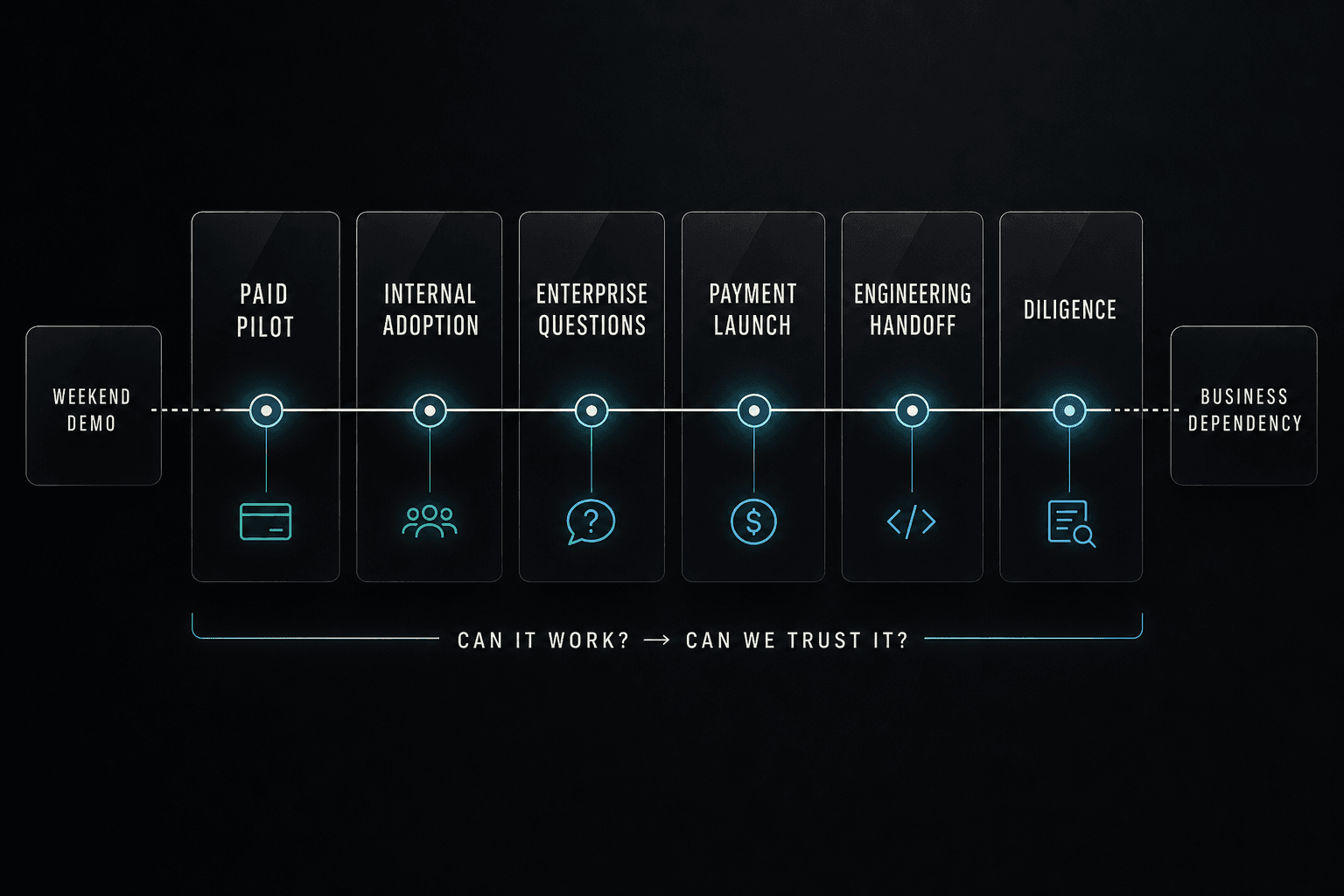
The wall usually appears when the product crosses a business milestone that changes the question from "can it work?" to "can we trust it?"
Why the wall exists
The wall exists because generating a working feature and owning a production system are different kinds of work.
AI coding tools are strongest when the problem looks familiar: a login form, settings page, API route, or dashboard. They can produce those pieces quickly because they have seen thousands of similar patterns.
Production software breaks in the spaces between those pieces. A permissions rule changes what an API route should allow. A billing state changes what a customer can access. A database shortcut works until two users hit the same workflow at the same time.
The hard part is not generating another component. It is keeping the whole system coherent as it changes.
That does not make AI-generated code useless. It means someone still has to own the architecture, the security model, and the process for verifying changes.
The real debt is often comprehension debt: code generated faster than anyone on the team can explain it. The UI works. The demo flows. But nobody can say, with confidence, how permissions are enforced, where the important state lives, what happens when an integration fails, or which parts are safe to change.
That concern is starting to show up in research. GitClear's 2025 analysis looked across 211 million changed lines from 2020 through 2024 and found rising code clones alongside falling refactoring-style movement. [3] The pattern is not "AI makes bad software." It is simpler: faster output does not automatically create shared understanding.
DORA's 2025 research makes a similar point from the management side: AI acts as an amplifier, magnifying strengths and weaknesses already in the system. [4] Its 2026 ROI guide adds that teams should expect an initial productivity dip and only get durable returns if they can turn local coding speed into stable delivery. [5]
What breaks when the prototype leaves demo conditions
The first failures are rarely dramatic. More often, the product still looks finished while important guarantees are missing underneath.
A user can sign in. The dashboard loads. The form submits. The API returns something. From the outside, the product looks 80% finished. From an engineering perspective, the riskiest 20% may barely exist: authorization, data integrity, deployment discipline, observability, dependency review, and a plan for failure.
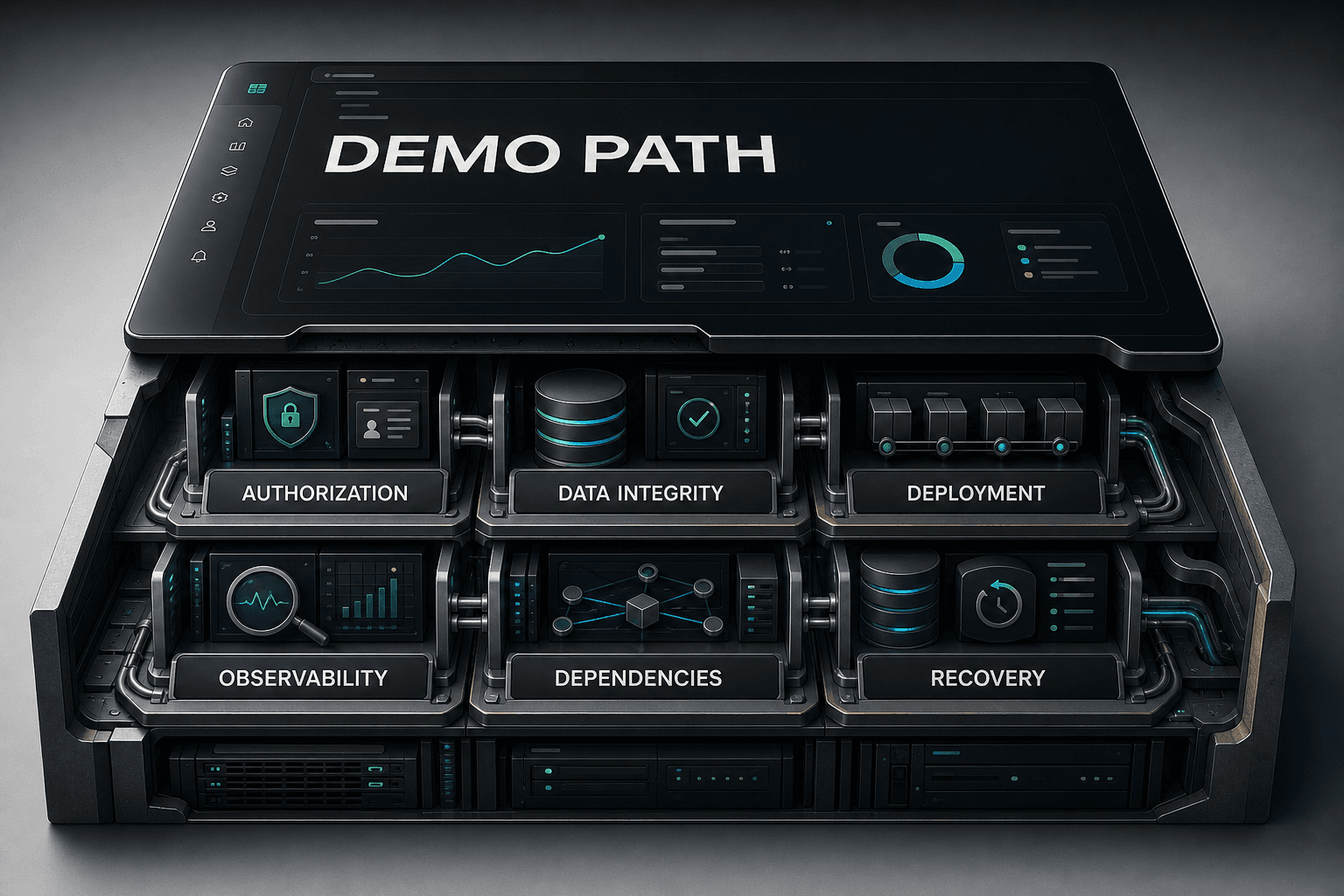
The visible demo path is only the top layer. Production depends on guarantees that are usually invisible during a prototype review.
This is where teams get surprised. A logged-in user can see another customer's records because authorization was never enforced properly. An admin route checks whether someone is signed in, but not whether they should be there. Secrets end up in source code or logs because the fastest path to a working integration was also the least safe. A database policy is more permissive than the UI suggests. A generated fix solves one bug and creates two more somewhere else.
These are not edge cases. They are common software failures, now easier to generate at prototype speed.
For a business, the failure modes usually look like this:
- Access risk: users can see or change data they should not touch.
- Data risk: records are duplicated, overwritten, leaked, or changed in ways nobody can reconstruct.
- Dependency risk: packages, APIs, generated integrations, or model-suggested libraries have not been vetted.
- Operational risk: there is no clean deployment process, logging, monitoring, backup, rollback, or incident path.
- Maintainability risk: every new change gets slower because nobody knows which parts of the system are safe to touch.
- Product risk: the system supports the demo path but not the real workflow customers, employees, or operators need.
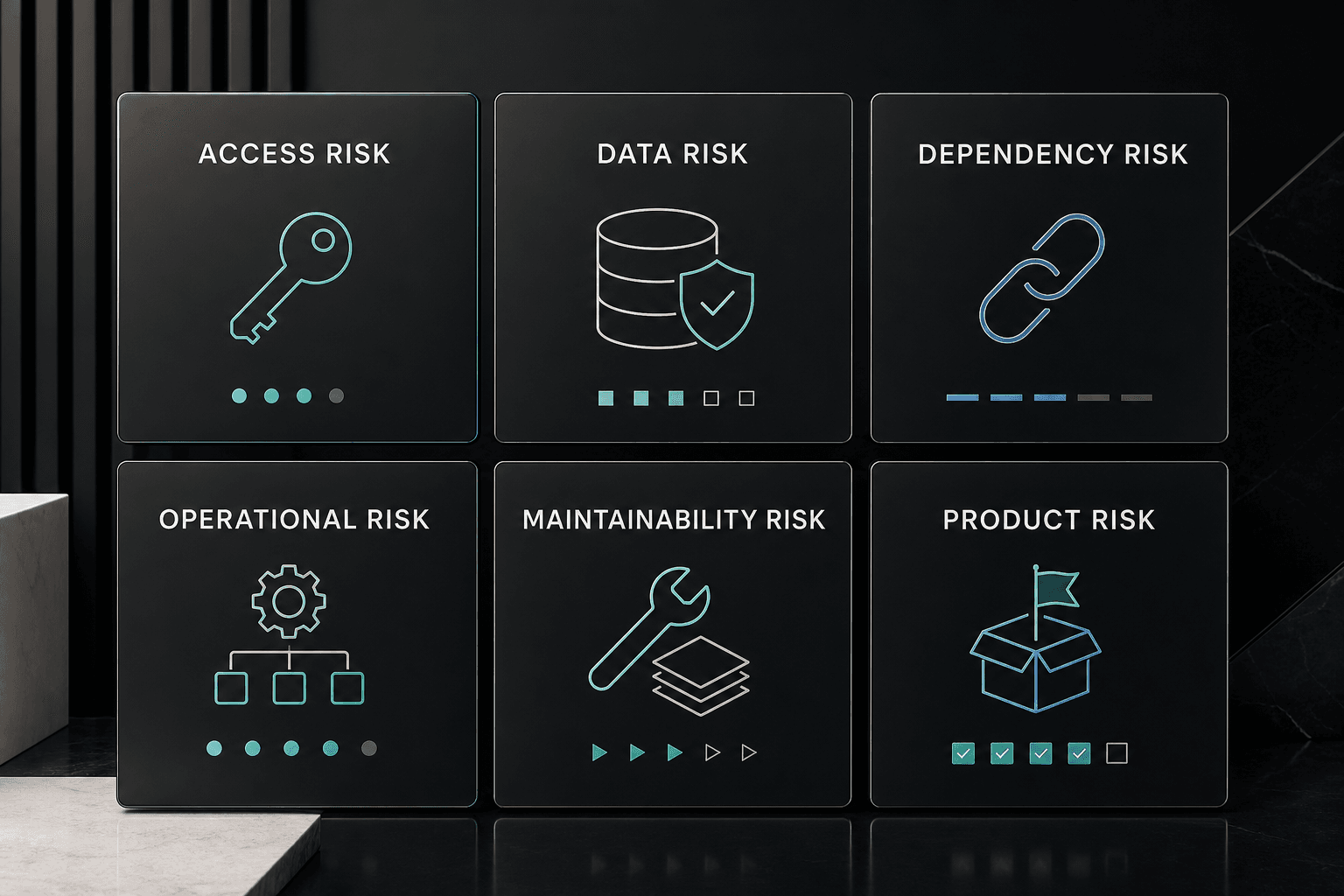
The main risks span access, data, dependencies, operations, maintainability, and product fit.
Authentication is where "it works" and "it's safe" start to diverge. In a prototype, authentication often means the user can log in. In a real product, that is the beginning of the problem. You also need to know how roles are enforced, how sessions expire, how resets work, how object-level permissions are checked, and what every endpoint allows after login.
Endor Labs notes that prompts without explicit security guidance often produce applications with missing authentication, broken access control, hard-coded secrets, or overly broad backend access. [6] The model is not trying to fool you. It is doing what it does best: producing code that looks like a reasonable answer. The trouble is that "reasonable-looking" is not the same thing as correct.
One concrete risk: AI-suggested packages
Dependency risk is easy to underestimate. AI tools do not only generate application code. They also suggest packages, libraries, and integrations, and those suggestions can be wrong in ways that create supply-chain exposure.
USENIX researchers found in 2025 that every coding model they tested hallucinated package names. Across 16 models, the average hallucination rate was 19.6%, and the study surfaced more than 205,000 unique nonexistent package names. [7]
That creates a straightforward supply-chain risk. If a model repeatedly invents plausible package names, an attacker can register one and wait for somebody to install it.
This matters especially for builders who do not live in the dependency ecosystem every day. If the model says "install this," and you do not already know which libraries are real, maintained, and widely used, you may not see the risk until it is too late.
The practical move is not to throw the prototype away. It is to de-risk it deliberately: map what the system does, identify the parts that handle trust, and decide what can be kept, what needs refactoring, and what should be rebuilt before the business depends on it.
Different AI builders create different blind spots
The wall looks different depending on where the tool hides complexity.
Some tools sell the full "idea to app" path. Replit Agent describes a natural-language path to apps and sites with "no-code needed." Its docs say Replit web apps are full-stack by default, and Replit can help add databases, auth, deployment, and payments. [10] [11] [12] [13] [14]
Lovable is moving in the same direction: natural-language app creation, editable code, hosting, database, auth, storage, integrations, GitHub sync, and payments. Its own security documentation is a useful reality check: automated scans do not replace a thorough security review, especially for sensitive or critical apps. [15] [16] [17] [18]
Emergent uses the "vibe coding" language directly, promising full-stack web and mobile apps in minutes, instant deployment, data connections, integrations, custom agents, GitHub integration on paid plans, and an AI-agent workflow that can design, code, and deploy an application from start to finish. [19] [20]
Vercel's v0 sits closer to the interface and deployment layer. It promises "Prompt. Build. Publish," GitHub sync, tool and API integrations, and one-click deployment to Vercel. Vercel's broader AI platform adds infrastructure for AI apps: AI SDK, AI Gateway, sandboxing, compute, observability, and deployment. [21] [22] [23]
Bolt and Firebase Studio show the same market pressure from different directions. Bolt emphasizes chat-built apps, websites, hosting, databases, integrations, auth, SEO, analytics, custom domains, and support for tools like GitHub, Stripe, Supabase, and Netlify. Firebase Studio brings Google's version of the pattern: a browser workspace with Gemini, an app prototyping agent, Firebase services, GitHub workflows, hosting, and cloud deployment paths. [24] [25] [26] [27]
This is not a toy category anymore. These products are moving past the blank-page problem and into the first version of the product stack: UI, database, auth, hosting, payments, integrations, repo sync, and deployment.
That is why the wall matters.
The more complete the platform feels, the easier it is to inherit production responsibilities without noticing. A generated app can have a database before anyone has reviewed the data model. It can have login before anyone has checked object-level permissions. It can accept payments before anyone has mapped refunds, failed payment states, access revocation, taxes, or accounting handoff. It can deploy before anyone has decided who owns logs, rollback, incidents, secrets, and vendor lock-in.
The business question is not which tool is "safe." The better question is what kind of oversight the tool requires before the product handles real stakes.
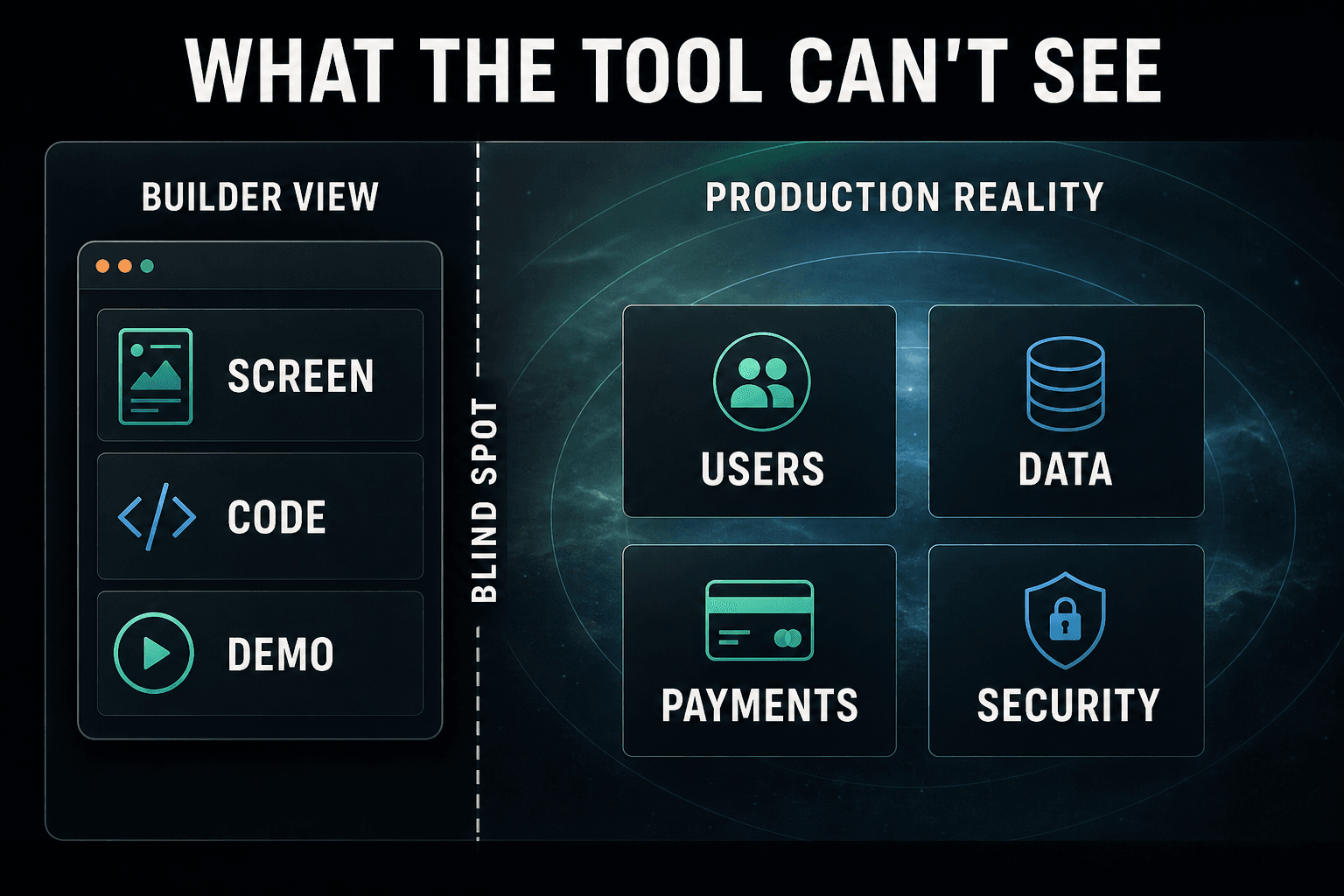
Builder tools can make the screen, code, and demo feel complete while the operating reality around users, data, payments, and security remains under-reviewed.
Decision gates before real stakes
A team does not need to turn every prototype into an enterprise platform. The amount of process should match the blast radius.
Use the wall as a decision gate:
- Before real customer data: review authentication, authorization, database rules, backups, and data retention.
- Before payment: review billing logic, tax or accounting integration, refund paths, access after failed payment, and auditability.
- Before enterprise sales: prepare answers on permissions, uptime, audit logs, incident response, and data handling.
- Before internal adoption: assign an owner, document the workflow, create a fallback process, and monitor errors.
- Before engineering handoff: map the architecture, dependencies, data model, test coverage, and known shortcuts.
- Before fundraising or diligence: make sure someone can explain what has been built, where the risks are, and what the next technical plan looks like.
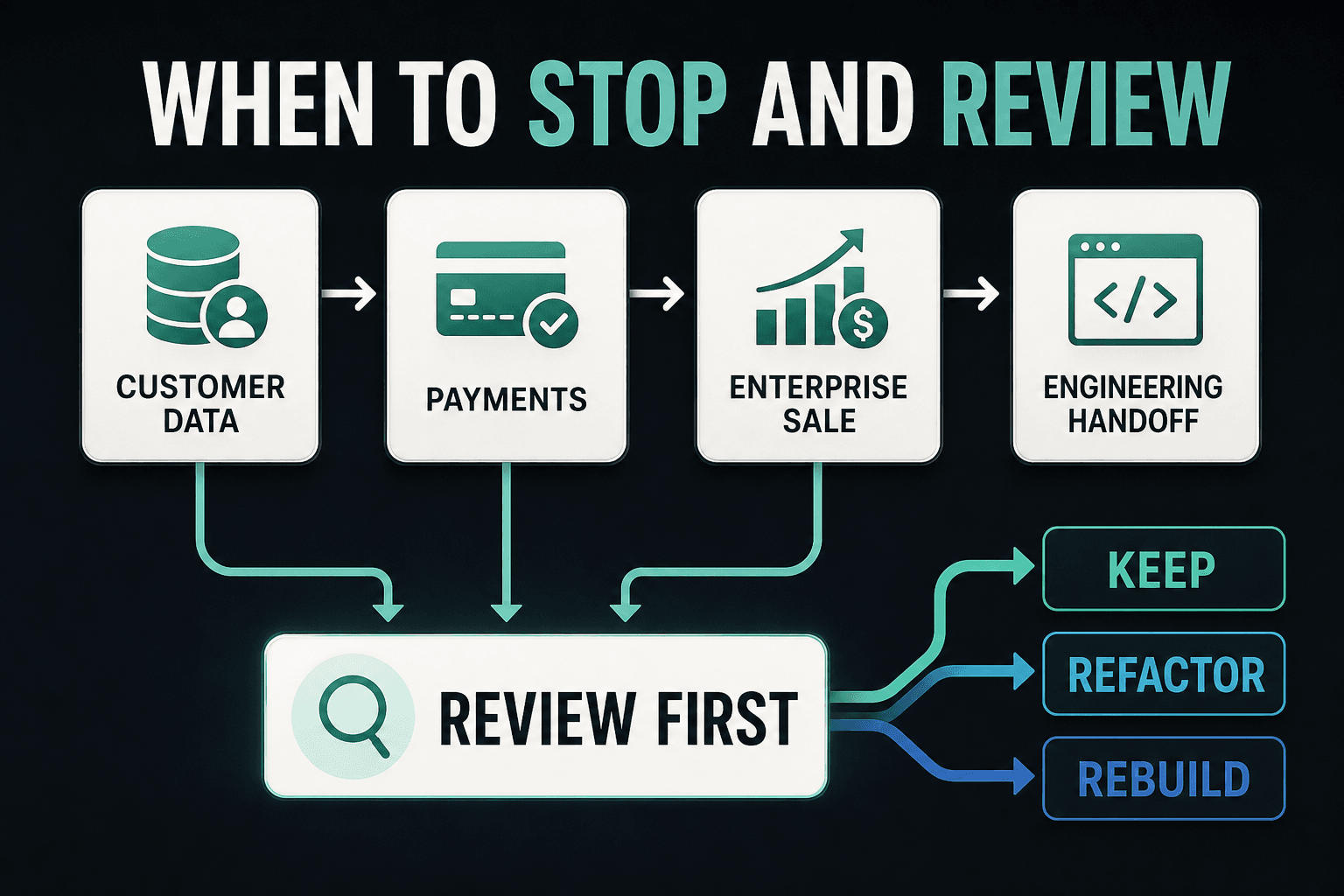
When customer data, payments, enterprise sales, or engineering handoff appear, review first, then decide what to keep, refactor, or rebuild.
Diligence does not stop at the interface. Serious customers, investors, and technical hires will want to know whether the system can be understood and changed without guesswork.
How to de-risk an AI-built prototype
The right response to the brick wall is calibration. Do not assume the prototype is production-ready. Do not assume it has to be thrown away either. Review it against the risk it is about to carry.
A production-readiness review should not start with "is the code good?" That question is too vague. Start with a more useful one: can the team explain what happens when the easy path breaks?
A practical review usually works in this order:
- Map the app, database, services, integrations, deployment path, and generated-code dependencies.
- Identify trust boundaries: authentication, object-level authorization, roles, database rules, secrets, and sensitive endpoints.
- Trace important data flows: customer records, payments, files, audit events, internal workflow state, and anything that cannot be casually lost or overwritten.
- Inspect packages, APIs, generated integrations, model-suggested libraries, and cloud services.
- Add tests around login, permissions, payments, destructive actions, data updates, and rollback paths.
- Check logging, monitoring, backups, deployment, environment variables, error handling, and incident response.
- Decide what to keep, refactor, or rebuild before the next business milestone.
The output should not be a vague bug list. It should give the team a system map, ranked risks, trust-boundary review, data-flow map, critical-path test plan, and a practical path to the next milestone.
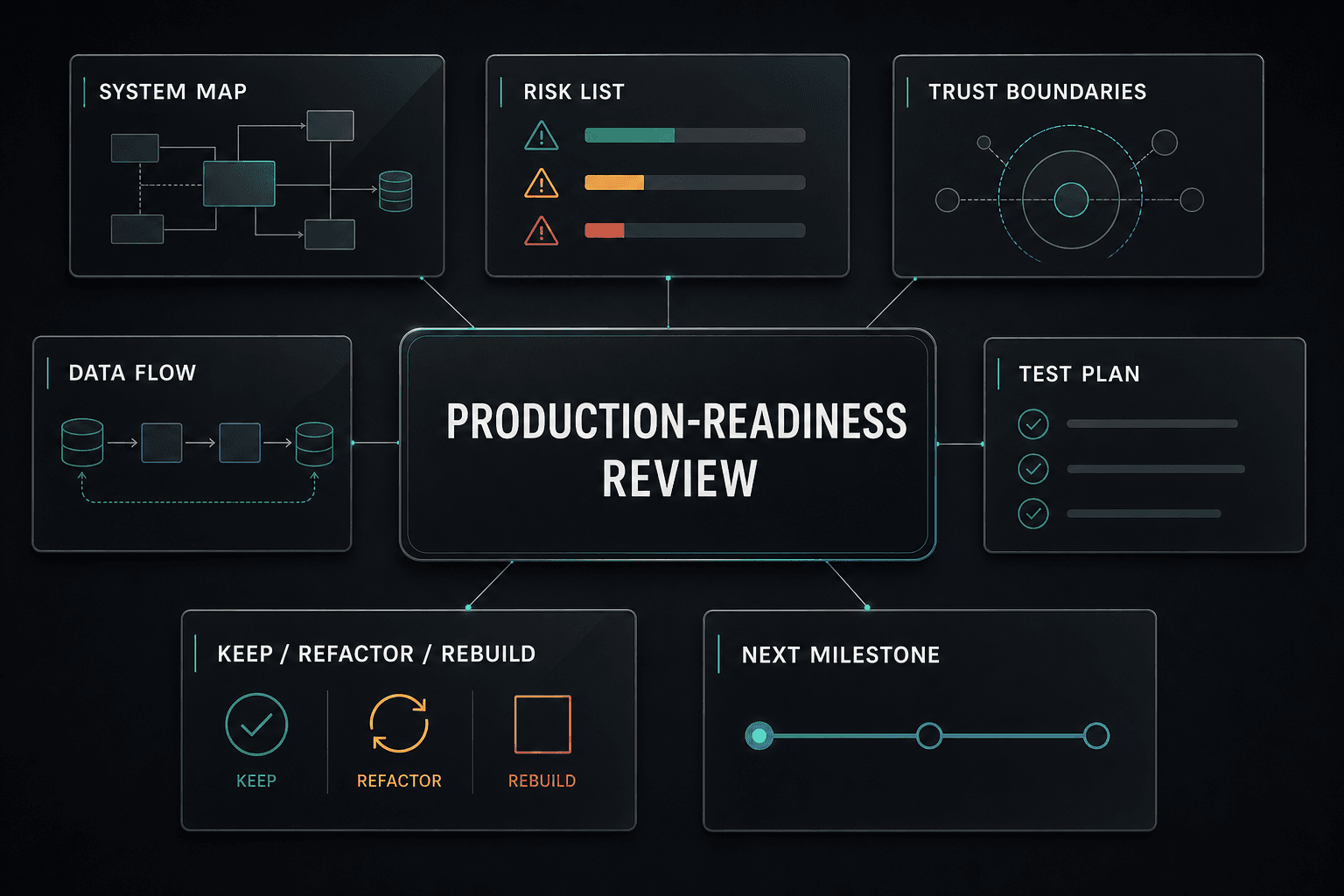
A useful review produces concrete outputs: a system map, ranked risks, trust boundaries, data flow, tests, a keep/refactor/rebuild decision, and the next milestone.
AI can help with some of this cleanup. It can draft tests, summarize architecture, generate documentation, spot inconsistent patterns, and help inspect dependencies. The mistake is not using AI for review. The mistake is treating the AI's review as the final authority when the system is about to carry business risk.
When to bring in engineering judgment
Bring in engineering judgment before the cost of being wrong becomes high, not after.
That may be when the product touches customer data, when a buyer asks serious questions, when revenue starts flowing through the system, or when the team needs to keep shipping without breaking what already works.
The right expert depends on the risk. Sometimes the gap is security. Sometimes it is architecture, deployment, data modeling, integration design, or domain workflow. The goal is to match the review to the business risk, not add generic engineering ceremony.
The useful frame is minimum viable process: just enough review, testing, documentation, and operational discipline to keep the next business milestone from becoming a technical liability.
AI can help you reach a proof point faster. Expertise and process help you keep that proof point from becoming a fragile business dependency.
What teams should take from this
The strongest teams using AI coding tools do not pretend the wall does not exist. They use AI to reach a proof point faster, then get honest about what must be true before the system can carry real business weight.
Treat AI-generated output as scaffolding, not truth: useful, fast, and still in need of inspection. A working demo is not the same thing as a trustworthy system. Any tool that makes backend complexity feel magically solved deserves a second look.
Vibe coding is not a fraud. It is a very good way to get to the beginning.
The brick wall is what comes next: the point where a convincing prototype needs engineering judgment, operating discipline, and a path to production.
When the prototype is promising enough to protect
If an AI-built prototype is starting to carry real business weight, the next step is not always a rebuild. Often, the first move is a clear read on what is safe, what is fragile, and what needs to change before customers or operators depend on it.
Perssonify has experience taking over vibe-coded MVPs and AI-built prototypes, then building them into hardened, complete products. That work usually starts with understanding what the prototype already proves, then separating the parts worth keeping from the parts that need stronger architecture, security, data handling, testing, deployment, and product execution.
If you are facing that transition and want to understand what the next stage could look like, we'd love to discuss your project. Reach out to us at hello[at]perssonify.com.
FAQ
Can AI app builders create production-ready software?
They can contribute to production software, but not by default. The generated output still needs review, tests, security work, architecture ownership, and a clear deployment process.
What is the biggest risk for teams using AI-built prototypes?
Mistaking visible progress for production readiness. The interface may look complete while permissions, data integrity, observability, tests, and maintainability are still weak.
Are tools like Lovable, Replit, Emergent, v0, Bolt, and Firebase Studio only for prototypes?
No. Many now reach into databases, auth, hosting, payments, integrations, GitHub sync, and deployment. That makes them more useful, but it also means builders may inherit production responsibilities earlier than expected.
When should a team bring in technical expertise?
Before the prototype handles customer data, payments, contracts, compliance-sensitive workflows, internal operations, or an important pilot. Another trigger is uncertainty: if nobody can explain how the system works end to end, it is time for review.
Does hitting the vibe coding brick wall mean the prototype failed?
No. It often means the prototype succeeded enough to matter. The brick wall is where exploration needs to become engineering: architecture, security, testing, operations, and a plan for what happens next.
How can a business de-risk an AI-built product without losing momentum?
Start with a focused production-readiness review. Map the architecture, inspect trust boundaries, review dependencies, add tests around critical flows, improve deployment and monitoring, and decide what to keep, refactor, or rebuild.
Sources
-
Vibe coding definition and context
- [1] Simon Willison, "A quote from Andrej Karpathy," February 6, 2025.
-
AI developer adoption and productivity
- [2] Stack Overflow, "2024 Developer Survey: AI."
-
AI code quality, maintainability, and delivery research
-
Security and dependency risk
-
AI coding environments and app-builder platforms
- Cursor
- Replit
- Lovable
- Emergent
- [19] Emergent product site.
- URL: https://emergent.sh/
- [20] Emergent pricing page.
- [19] Emergent product site.
- Vercel and v0
- [21] v0 by Vercel product site.
- URL: https://v0.app/
- [22] v0 documentation.
- URL: https://v0.app/docs
- [23] Vercel AI platform page.
- [21] v0 by Vercel product site.
- Bolt
- [24] Bolt product site.
- URL: https://bolt.new/
- [25] Bolt support center.
- [24] Bolt product site.
- Firebase Studio
Written by
Perssonify
Perspectives, frameworks, and lessons from the Perssonify team on building AI-driven products that work in production.